Saubha Aerial Systems – Building Safety Layer for Autonomous Airspace
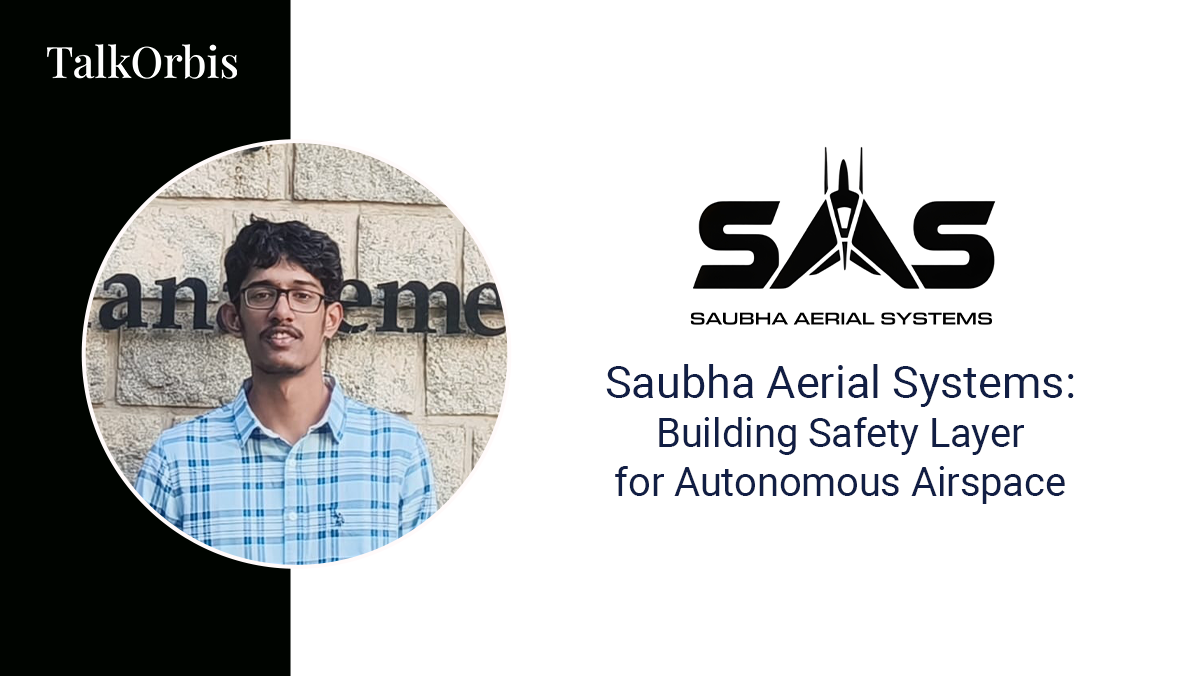
Naijith Rai, CEO of Saubha Aerial Systems
Naijith Rai is the CEO of Saubha Aerial Systems, which is building the safety layer for autonomous airspace. The company is developing autonomous rescue systems for drones to enable their safe, large-scale adoption, along with cost-effective autonomous interception systems for rogue drones to help ensure that the country does not have to saturate its defence resources during drone-based warfare.
SUMMARY
- Building the safety layer for autonomous airspace, protecting people and infrastructure from both drone failures and rogue drone threats.
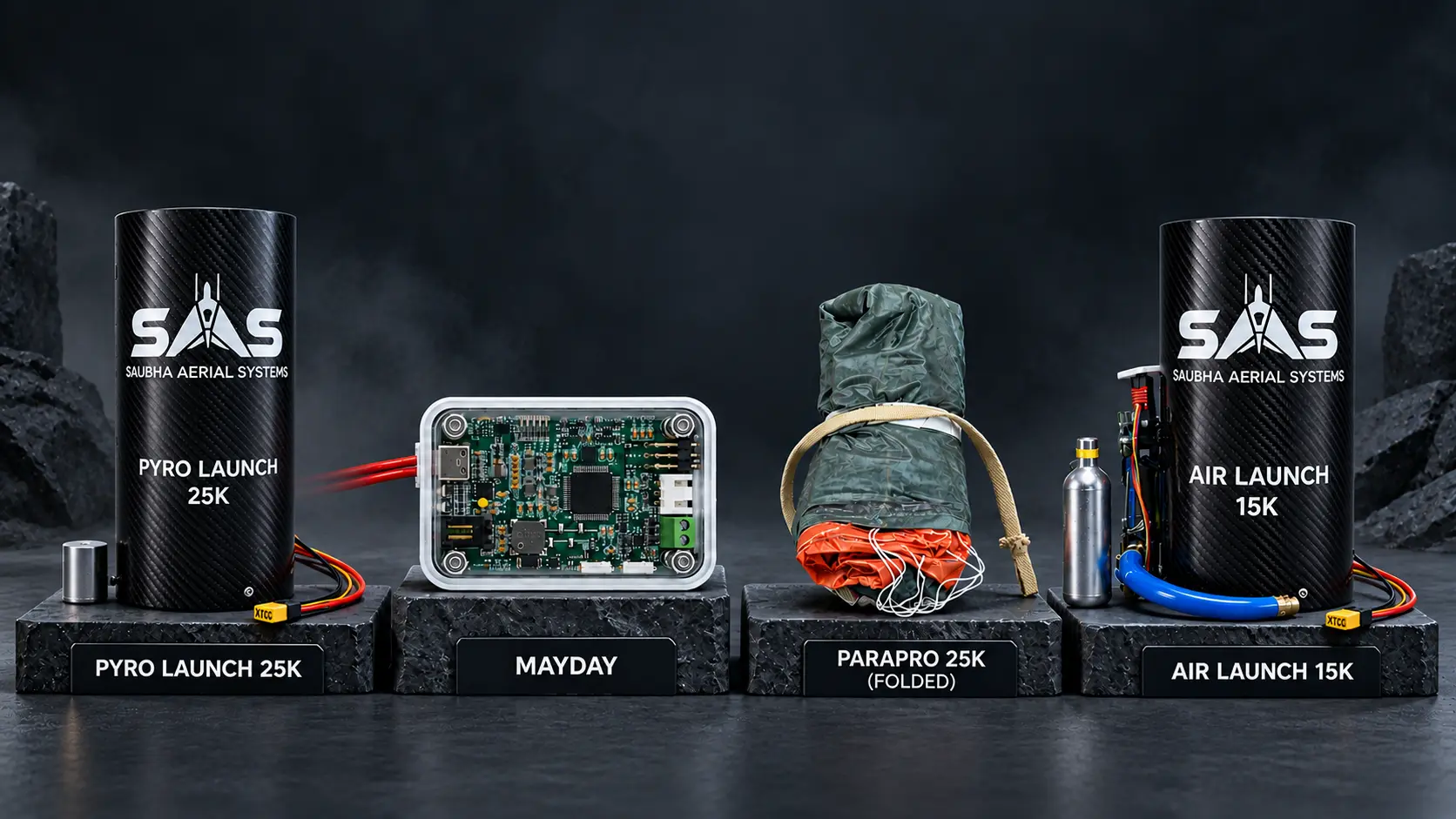
- Developed Mayday, an autonomous parachute trigger system that detects drone failures and deploys a parachute within 500 ms, independent of the flight computer.
- Developing net guns and autonomous interceptor drones to safely neutralize rogue drones and protect military assets and critical civilian infrastructure.
Could you tell us a little about your journey as founders and how your early experiences with building and experimenting with drones led you to start Saubha Aerial Systems?
The founding team of Saubha Aerial Systems met while studying Aerospace Engineering at RV College of Engineering, graduating in 2023. Their drone journey gained momentum through SAE AeroTHON, where they ranked among India’s top 10 teams, followed by winning AeroHelix at IIT Roorkee. During testing, repeated drone crashes highlighted critical safety risks, inspiring them to develop a lightweight, autonomous parachute recovery system.
To fund development, they launched ProjectX Labs, offering technical workshops and engineering services. Using the revenue, they built their first MVP, secured grants, and officially founded Saubha Aerial Systems in 2025.
While working with drones, you experienced the challenges and losses that can come with crashes. When did you realize that drone safety itself could be a problem worth solving, and how did that insight shape Saubha?
We first understood the problem of drone safety during college. We had been given a budget of around ₹1 lakh to build our competition drone, and we were barely able to complete it within that amount. During testing, we experienced a crash that damaged the airframe, motors, and electronics. Since the project budget was already exhausted, we had to put in our own money to repair the drone and continue testing. But while developing our MVP, we began to understand that the much bigger issue was the risk to people, property, and the payload being carried.
Around the same time, several drone delivery companies were conducting trials with heavier drones. We came across incidents where a 20+ kg delivery drone lost control after hitting an apartment complex and crashed near a children’s play area. We realised that as drones become larger, more autonomous, and more widely deployed, safety cannot remain an afterthought. That insight became the foundation for Saubha Aerial Systems and our mission to build the safety layer for autonomous airspace.
We realised that the real cost of a drone crash isn’t the drone itself—it’s the risk it creates for the people, property, and critical payloads beneath it
How did the idea of an autonomous emergency parachute system evolve into an actual working product? What were some of the biggest challenges in developing the first prototype?
A parachute system needs to respond correctly in a critical situation. What technical challenges did you face in detecting failures and ensuring the system could deploy quickly and reliably?
There were two major challenges: making the mechanical system extremely lightweight and reusable, and making the autonomous firmware robust enough to avoid false triggers while still detecting a real failure quickly. On the mechanical side, we used lightweight composites such as carbon fibre in the ejection system and developed compact reusable latch mechanisms to reduce weight without compromising reliability.
The system had to remain completely inactive during normal flight, but respond within milliseconds once a genuine failure occurred. To refine the sensor-fusion and detection algorithms, we mounted the electronics on test drones and accumulated more than 100 hours of flight testing across 300+ flights. For larger drones, we initially used pyrotechnic deployment systems. However, some customers required a non-explosive solution for 20+ kg platforms. The system can puncture a CO₂ cartridge in mid-air and rapidly eject the parachute while remaining lightweight and reusable.
What were some of the most difficult or unexpected moments during testing? Were there any prototypes, assumptions, or approaches that failed and forced the team to rethink the solution?
One of the most difficult moments during testing was losing a 25 kg drone because of a very simple human error. As a team, we conduct extensive ground testing before taking any new system into the air, so purely technical failures have been relatively rare. During one trial, we fitted our parachute ejection system to a 25 kg drone, took it to around 40 metres, and intentionally switched off the drone, expecting the autonomous system to detect the failure and deploy the parachute. However, we had forgotten to switch on the autonomous trigger board.
At the time, the autonomous safety system was designed as a completely independent add-on with its own battery. After the incident, we realised that independence should not come at the cost of relying on the user to remember to switch on or charge the system. We therefore introduced a continuous-charging architecture for the dedicated safety battery and integrated communication between the autonomous board and the flight controller. The drone is now prevented from taking off unless the safety system is powered, healthy, and ready.
How did the journey from building drones as students to developing safety and counter-drone technologies change the way you approached engineering, testing, and real-world requirements?
During college, we were part of several technical clubs, and I was personally involved with Team Antariksh, our rocketry club. That experience taught us the fundamentals of how engineering problems should be approached: understand the problem, build a prototype, test it, learn from the failures, and keep iterating until the solution works reliably.The biggest difference is in where the problem statement comes from. During college, the challenge was usually defined by a competition or was something we came up with ourselves.
Today, the problem statement comes from customers, operators, and real-world environments. That shift has significantly changed the way we think about engineering. A technically impressive solution has very little value if it does not solve a real problem for the customer. We now spend much more time understanding operating conditions, integration constraints, reliability, maintainability, weight, cost, and how the system will actually be used in the field. One of the most important lessons we have learned is to build a solution for a problem that already exists, rather than building a solution first and then searching for a problem it can solve.
As drones move into areas such as logistics, infrastructure, defence, and other critical applications, what role do you believe safety and recovery systems will play in making wider drone adoption possible?
As drones move from controlled testing environments into logistics, infrastructure, defence, and other critical applications, safety and recovery systems will become a key enabler of wider adoption.
The more drones we put into the air, especially over populated areas, the less acceptable it becomes for a single motor, battery, software, or communication failure to result in an uncontrolled crash. For high-value payloads and larger platforms, the consequences become even more significant.
We believe recovery systems such as autonomous parachutes will eventually become a standard safety layer, similar to how other industries have built redundancy and fail-safe mechanisms into critical systems.
For large-scale drone adoption to happen, regulators, operators, and the public need to trust that failures can be handled safely. That is where independent safety systems become important.
Ultimately, autonomy can scale only when safety scales with it. Our goal is to build that safety layer so that drones can operate more widely, more frequently, and with greater confidence.
Large-scale adoption of drones to solve everyday problems will only be possible when safety becomes a built-in part of every autonomous system
What is your vision for Saubha Aerial Systems over the next few years, and what new technologies, applications, or markets are you hoping to explore?
Our vision is to build the safety layer for autonomous airspace.Over the next few years, we want to develop cost-effective, autonomous, and EW-resilient counter-drone systems, and extend the same resilience technologies to other defence UAV applications.Our immediate focus is to prove these systems in defence environments. Once proven, we plan to expand into critical civilian infrastructure such as oil refineries, airports, ports, and energy facilities.
Trending Interviews










Trending Interviews
Related Popular Interviews
-
 By Prerna Saini | October 06, 2026
Sanyark Space: Building India’s Navigation Satellite Backbone
Read More -
 By Prerna Saini | October 02, 2026
From Voice Agents to Voice-First Hardware:The Story Behind Antimattr
Read More