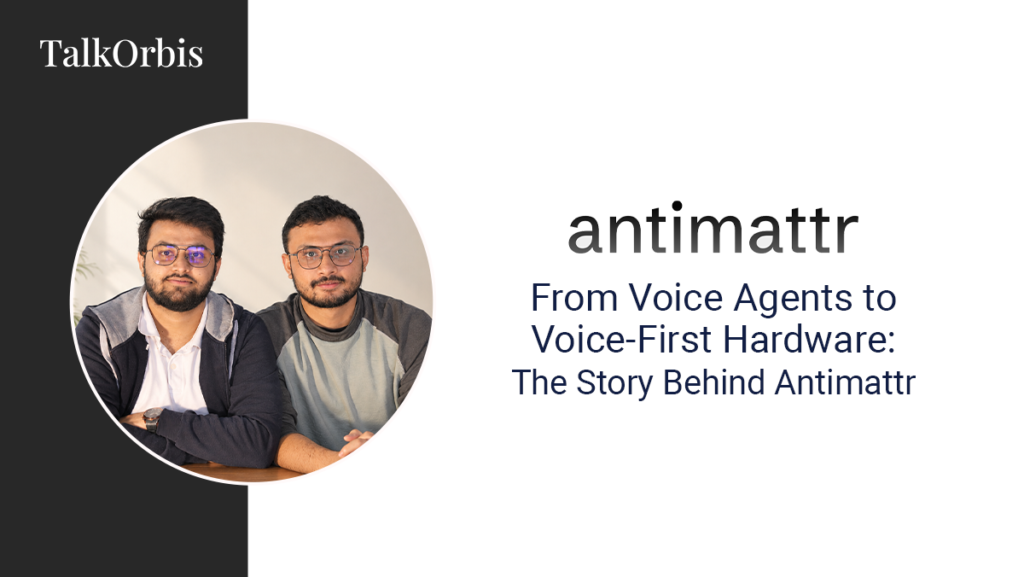
From Voice Agents to Voice-First Hardware:The Story Behind Antimattr
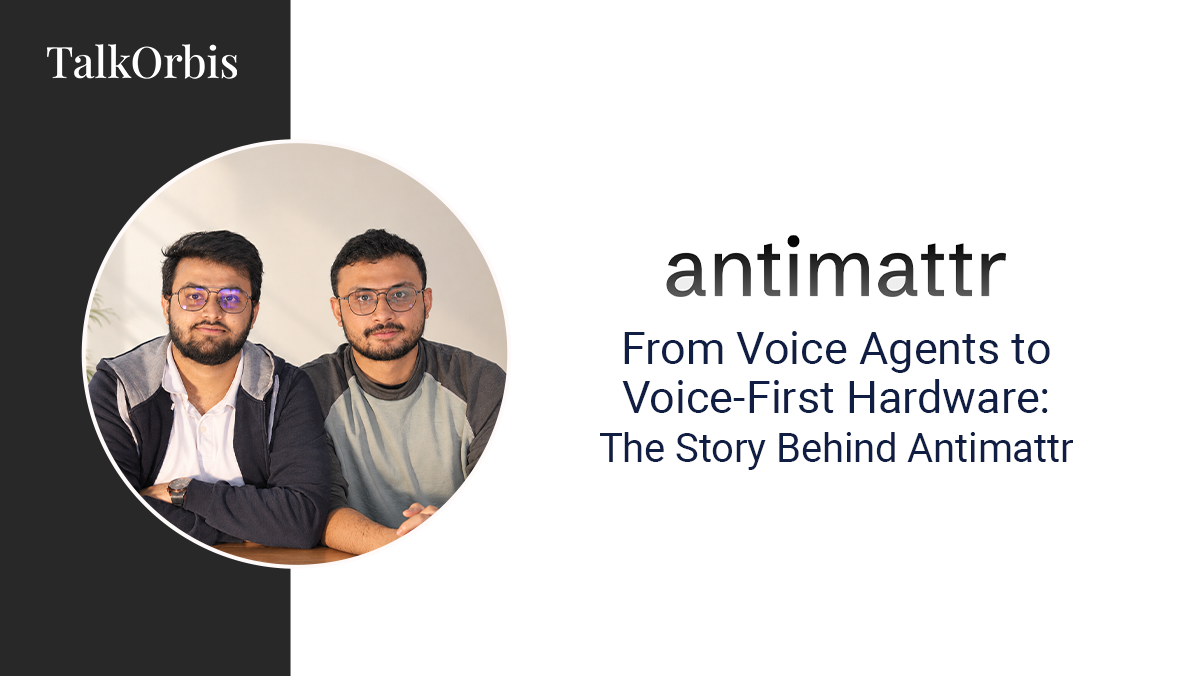
Sridipto Ghosh - co-founder & CEO , Sirsho Chakraborty - co-founder & CTO
Sridipto is the co-founder and CEO of antimattr, a Bengaluru/SF-based AI hardware startup building voice-first devices, starting with project mnemosyne, ring and a pair of earphones for voice productivity. An IIT (BHU) graduate, he previously co-built the software startup, Snipe. At antimattr, he is working to make voice the most natural way humans interact with machines.
SUMMARY
- Antimattr’s broader vision for changing how humans interact with AI and technology
- The thinking behind Project Mnemosyne and its approach to voice, memory, and productivity
- How Sridipto Ghosh and the antimattr team moved from building voice agents to creating a new hardware interface for human–AI interaction.
Before antimattr, you were already building voice agents. What kept breaking in real-world use and made you realise the problem was actually the hardware?
The models were never the problem. By the time we were building voice agents, speech recognition and language models were good enough. What kept breaking was everything around them.
Phone microphones picked up the café, the traffic, the person at the next desk. Wake words were unreliable and slow. The biggest failure wasn’t technical at all: it’s the noise around.
That was the realisation. Voice AI adoption isn’t bottlenecked by model quality. It’s bottlenecked by noise. You can’t fix that with a better prompt or a faster API. The capture has to happen closer to the mouth. It has to work when you speak softly in a noisy environment.
project mnemosyne is described as an “audio computer.” What does that mean in practical terms, and how is it different from simply putting AI into earbuds?
We have dropped the “audio computer” positioning. Antimattr position project mnemosyne as “the interface for voice”. As voice is the primary input, audio is the primary output.
What made you believe that a ring + earphones could become a more natural interface for memory and voice productivity?
We looked at where the friction actually sits. Earphones are already worn for hours a day and sit right next to your mouth, which makes them the best place to capture voice. What they lack is great “voice isolation” – the ability to block the background noise completely. A thumb against a finger is the fastest, most private gesture humans have. Nobody notices it. So, the ring became the input device.
What has building physical hardware taught you that your earlier software startup never could?
Hardware is hard, consumer hardware is brutal and that’s the reason it’s very a humbling journey. When you realise and see there are thousands of people working across the lifecycle of a simple product like a light bulb, it grounds you. Founder intuition and conviction play a very important role. Hardware forces you to make decisions early and live with them.
Hardware also requires you to travel, a lot. Factories, suppliers, manufactures. We spent time in China, met so many manufacturers and narrowed that to a few we could actually build with. Above all, hardware teaches patience and increases your ability to absorb discomfort in extreme situations. Atoms have lead times. Software never teaches that.
Hardware takes time and patience. Good things take time; great things take patience.
From your early experiments to building project mnemosyne, was there a particular moment that made you feel antimattr could become something much bigger than the original idea?
I feel the way to go is to
- keep listening to your users and customers
- chase harder problems
- don’t settle for anything mediocre, build great products
project mnemosyne is only the first chapter. What are you ultimately trying to change about how humans interact with machines?
Our long-term vision is building an ecosystem of devices for human-machine interaction. We strongly believe the future of personal AI is private and not on cloud. A private local computer that runs all your models and has all the context. This is project soteria – the next milestone for us. Because true freedom begins with privacy and ownership. The final frontier for antimattr is project athena – the machine that defines how humans move. This always reminds us why we started, what inspired us and why we chose greatness.
project athena will keep reminding us why we started and keep pushing us towards greatness.
If antimattr succeeds exactly as you imagine, what will using technology feel like five years from now?
Everyone will build and run agents. It’s still a fraction of humans who agents (even a fraction of people using AI). We believe in the near future everyone will use/build/run agents on their own; just like today anyone can use a smartphone.
Trending Interviews










Trending Interviews
Related Popular Interviews
-
 By Prerna Saini | October 09, 2026
Saubha Aerial Systems – Building Safety Layer for Autonomous Airspace
Read More -
 By Prerna Saini | October 06, 2026
Sanyark Space: Building India’s Navigation Satellite Backbone
Read More