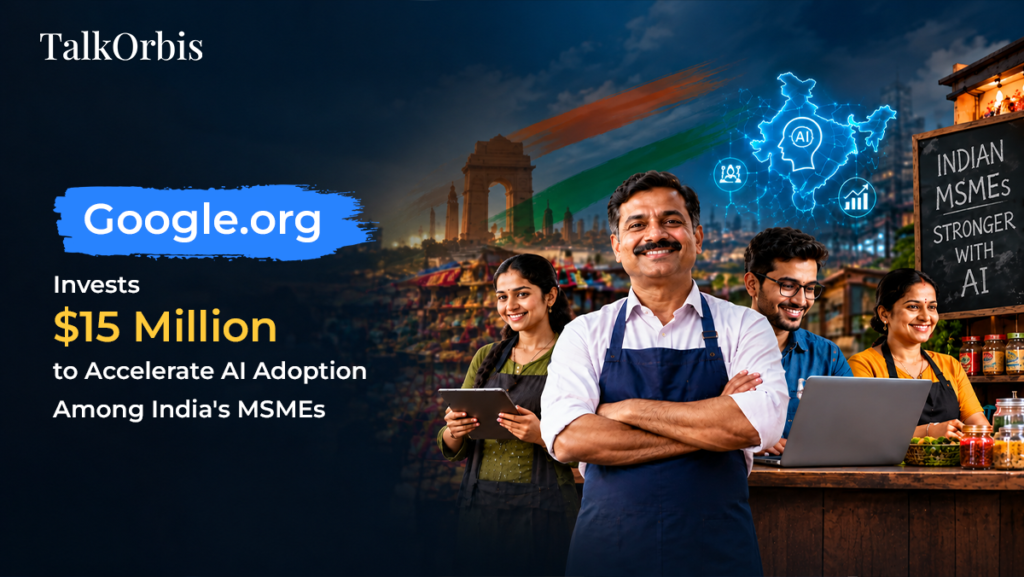
Google.org Invests $15 Million to Accelerate AI Adoption Among India’s MSMEs
Artificial intelligence (AI) is becoming an important driver of business growth, helping organizations improve productivity, automate repetitive tasks, and make smarter decisions. In India, micro, small, and medium enterprises (MSMEs) have significant opportunities to benefit from these technologies. However, limited resources, a lack of technical expertise, and low awareness can make AI adoption challenging for smaller businesses.
To help address these barriers, Google.org has committed $15 million to support AI adoption among India’s MSMEs. This initiative highlights the growing importance of making AI tools, knowledge, and resources more accessible to small businesses, enabling them to strengthen their operations and compete in an increasingly digital economy.
Why Is AI Adoption Important for India’s MSMEs?
MSMEs play a vital role in India’s economy by supporting employment, entrepreneurship, manufacturing, and service delivery. As customer expectations evolve and digital competition increases, these businesses need affordable solutions that help them operate more efficiently.
AI can help MSMEs improve several areas of their operations, including:
- Customer service: AI-powered chatbots can respond to common customer questions, provide product information, and support customers outside regular business hours.
- Marketing and sales: AI tools can help create marketing content, analyze customer behavior, and personalize promotional campaigns.
- Business operations: Automation can reduce repetitive administrative work, allowing employees to focus on more valuable activities.
- Inventory management: AI-based analytics can help businesses identify demand patterns and make better stock-planning decisions.
- Decision-making: AI can analyze business data and highlight trends that support more informed decisions.
With the right resources and guidance, even smaller enterprises can begin using AI without developing complex systems from scratch.
How Google.org’s $15 Million Commitment Could Support AI Adoption
Google.org, Google’s philanthropic arm, supports initiatives that use technology to address economic and social challenges. Its reported $15 million commitment to AI adoption among India’s MSMEs reflects the need to help smaller businesses participate in the expanding AI economy.
Such support can help address some of the most common challenges that prevent MSMEs from adopting emerging technologies.
1. Improving Access to AI Tools
Many small businesses assume that implementing AI requires expensive software, specialized developers, or significant infrastructure investments. However, a growing range of AI-powered tools can be accessed through cloud platforms and subscription-based services. Initiatives that improve access to these tools can help MSMEs explore practical applications such as automated customer support, content creation, document processing, and data analysis.
2. Building Digital Skills and AI Awareness
Access to technology alone is not enough. Business owners and employees also need to understand how AI works, where it can deliver value, and how to use it responsibly. Training programs, educational resources, and practical demonstrations can help entrepreneurs identify suitable AI applications for their businesses. This knowledge can reduce uncertainty and encourage more confident adoption.
3. Supporting Small Business Productivity
MSMEs often operate with limited teams and budgets. AI can help these businesses complete routine tasks more quickly and reduce the administrative burden on employees.A service provider could use AI to organize customer inquiries, prepare business documents, and improve lead management. These applications can help businesses save time while making better use of their existing resources.
4. Encouraging Inclusive Digital Growth
AI adoption should not be limited to large corporations or technology-focused startups. Small enterprises across different industries and regions also need opportunities to benefit from technological progress. Support for AI awareness, training, and implementation can help reduce the digital divide between large organizations and smaller businesses. It may also create new opportunities for entrepreneurs in sectors such as retail, manufacturing, logistics, agriculture, and professional services.
The specific beneficiaries, delivery partners, and program activities associated with the $15 million commitment should be confirmed against Google’s official announcement before publication.
How AI Can Transform Different MSME Sectors in India
AI applications vary depending on the business model, industry, and available data. Some practical examples include:
- Retail and E-commerce – AI can help online sellers generate product descriptions, recommend products, analyze purchasing behavior, and automate customer inquiries.
- Manufacturing – Manufacturers can explore AI-assisted quality checks, equipment maintenance planning, production forecasting, and workflow optimization.
- Professional Services – Consultants, agencies, and service providers can use AI to summarize documents, prepare proposals, organize information, and improve internal workflows.
- Logistics and Distribution – AI-powered forecasting and analytics can support route planning, demand prediction, inventory visibility, and delivery coordination.
Key Challenges MSMEs May Face When Adopting AI
Although AI offers significant opportunities, small businesses must approach implementation carefully. Several challenges can affect successful adoption.
- Limited budgets: Subscription fees, integration costs, and employee training can create financial pressure.
- Lack of technical expertise: Business owners may not know which AI solutions are suitable for their needs.
- Data quality issues: Incomplete or inaccurate business data can reduce the reliability of AI-generated insights.
- Privacy and security concerns: Businesses must protect customer information and avoid sharing sensitive data with unsuitable tools.
- Employee readiness: Teams may require training to integrate AI into existing workflows effectively.
Addressing these challenges requires more than access to software. MSMEs need practical guidance, appropriate tools, clear implementation goals, and ongoing support.
How Indian MSMEs Can Start Using AI
Businesses do not need to transform every operation at once. A gradual approach can help them understand AI’s value while controlling costs and risks.
- Identify repetitive tasks: Look for activities such as responding to common inquiries, preparing reports, or organizing product information.
- Choose a practical use case: Start with one task where automation could save time or improve service quality.
- Evaluate suitable tools: Compare features, pricing, data protection policies, and integration requirements.
- Train employees: Explain how to use AI tools and verify their outputs before relying on them.
- Measure the results: Track time saved, customer response times, operating costs, or other relevant business metrics.
- Expand gradually: Build on successful pilot projects before introducing AI into more critical processes.
This approach allows businesses to learn from experience instead of investing heavily in technology without a clear objective.
What This Means for India’s Digital Economy
Greater AI adoption among MSMEs could contribute to a more productive and digitally capable business ecosystem. When smaller enterprises can access appropriate technology, they may be better positioned to improve customer experiences, explore new markets, and respond to changing industry demands.
The benefits will depend on how effectively AI resources reach businesses and whether entrepreneurs receive the training and support needed to use them. Responsible adoption, workforce development, and affordable access will remain essential to achieving meaningful results. For India’s technology sector, this also creates opportunities for software developers, AI service providers, consultants, and digital transformation agencies to help MSMEs identify and implement solutions that fit their business needs.
Conclusion
Google.org’s reported $15 million commitment to accelerating AI adoption among India’s MSMEs draws attention to an important question: how can smaller businesses benefit from the same technological advances increasingly used by larger organizations?
AI can help MSMEs streamline operations, strengthen customer engagement, improve decision-making, and discover new growth opportunities. However, successful adoption requires more than technology. Businesses also need practical training, reliable tools, responsible data practices, and implementation strategies aligned with their goals.
As India’s digital economy continues to evolve, initiatives that make AI more accessible to smaller enterprises could help create a more inclusive environment for innovation and business growth.
The long-term impact will depend on how effectively these resources translate into practical skills, real-world applications, and measurable improvements for India’s small businesses.
Source : Google.org commits $15 million to boost AI adoption among India’s MSME
Trending News










Trending News
Related Popular News
-
 By Prerna Saini | November 19, 2026
Amazon Announces $7 Billion Green Energy Investment Plan for India by 2030
Read More