
Sanyark Space
Brief
 Verified Profile
-
Founded In
2025
-
Strength
32+ Employees
-
Market
India
-
Phone
+91 83339XXXXX
Stay Connected
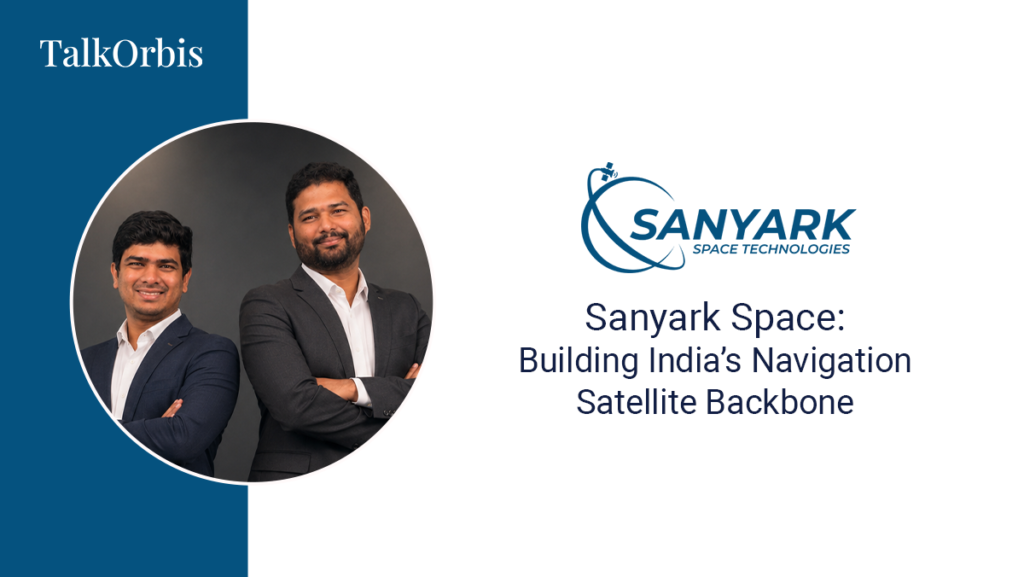
Sanyark Space was founded in 2025 by two former ISRO scientists, Raghava Kundrapu (Founder & CEO) and Akhileshwar Reddy Peseke (Co-founder). The company is based in Hyderabad and was incubated at T-Hub.
Raghava grew up in a family that ran a small hotel in Narsipatnam, Andhra Pradesh. Government and private scholarships paid for his education from Jawahar Navodaya Vidyalaya through his aerospace engineering degree at IIST, Thiruvananthapuram. He joined ISRO at Sriharikota as a launch vehicle scientist. Over eight years he contributed to more than 40 national missions across PSLV, GSLV, the human spaceflight Pad Abort Test and the Reusable Launch Vehicle programme. He then completed a PGP in Technology & Business at Masters’ Union and joined Deloitte as a Space Technology Consultant. There he worked on a PMO-led study of the SpaceTech value chain and emerging space technologies, and served as technical lead for the Karnataka Space Policy. He also did technical due diligence on spacetech startup fundraises.
The trigger came in 2023–24. NavIC was facing setbacks just as the government announced satellite-based GNSS tolling, which needs a precision that existing metre-level systems cannot deliver.
While researching the problem, and after reaching out to more than 100+ technical and business experts, Raghava met Akhileshwar through ISRO network. Akhileshwar Reddy had spent 13+ years on GNSS and NavIC at ISRO as a scientist too, led standards for NavIC receivers, Defence RS and worked on the GNSS tolling pilot. He holds a B.Tech from IIT Madras and has represented India in 3GPP and other international standards forums. After an year of working on the idea together, they founded Sanyark Space, three years earlier than Raghava had planned.
Our conviction was that India needs sovereign, next-generation navigation now, not a decade from now. While ISRO is building NavIC, alternative to GPS. We at Sanyark Space are building next-gen NavIC/GPS to solve for precision, resilience and autonomy at scale across both defence and commercial applications.
Products & Core Innovation
Sanyark Space is building India’s first integrated NAV-COM satellite constellation. It uses software-defined, multi-mission Low Earth Orbit (LEO) satellites that deliver two services from one platform:
- Centimetre-level Positioning, Navigation and Timing (PNT)
- Secure direct-to-device (M2M/IoT) communication aligned with 3GPP NTN standards
Today’s GNSS systems, including GPS and NavIC, transmit from medium or geostationary orbits up to 36,000 km away. Their signals arrive weak, easy to jam or spoof, and unreliable in cities and indoors. Sanyark’s satellites fly roughly 20 times closer, which delivers about 100 times stronger signals and much higher precision. This turns navigation from a guidance aid into an autonomy-grade system.
Sanyark’s approach has distinguishing features:
- It works with existing GNSS rather than replacing it: The satellites interoperate with NavIC and other GNSS, so existing receivers can use Sanyark signals and adoption can happen gradually.
- Navigation and communication share one timing reference: Both services run off the same precise onboard clock, which is why combining them on one platform is architecturally natural.
- The timing system has built-in redundancy: Chip-scale atomic clocks are synchronised with ground stations and existing GNSS constellations.
- Each satellite can carry extra payloads with optimised design architecture: Because the clock, RF front-end and compute are already on board, the satellite is designed to have additional payloads at marginal cost. Examples include space-based GNSS jamming and spoofing detection, GNSS-Reflectometry and Radio Occultation for weather and climate, and select defence payloads.
Impact & Applications
Positioning, navigation and timing are invisible infrastructure that modern life runs on. Yet India still depends heavily on foreign constellations: GPS (USA), Galileo (EU) and BeiDou (China). GNSS jamming and spoofing are now routine, with thousands of flights affected worldwide every day and nearly 2,000 interference incidents reported in Indian flight regions over two years. That makes this dependence both an economic risk and a security risk.
Sanyark’s NAV-COM infrastructure addresses this across several sectors:
- Mobility and transport: lane-level accuracy for ADAS and autonomous vehicles, and reliable satellite-based GNSS tolling that can tell a service road from a flyover
- Drones, aviation and maritime: resilient navigation in jammed or contested environments, plus command-and-control connectivity
- Defence and national security: a sovereign, jam-resistant PNT layer and space-based mapping of interference across Indian airspace and waters
- Telecom, energy and finance: precise timing to synchronise 5G networks and power grids and to time-stamp financial transactions
- Agriculture, logistics and industrial IoT: row-level precision farming and connectivity for assets in remote areas that terrestrial networks don’t reach
The market is large. By 2035 the world is expected to have more than 40 billion connected devices and over 2.5 billion positioning users, with around 1.5 billion use cases needing both navigation and connectivity at once. Few companies globally are attempting to combine the two like GeeSpace by Geely (China) and ESA’s Celeste. Beyond the commercial opportunity, Sanyark strengthens India’s strategic autonomy by complementing NavIC with a resilient, multi-layer national PNT ecosystem.
Future Goals
Sanyark has moved quickly. In under a year it has:
- raised US$2 million from Avaana Capital, AUM Ventures, T-Hub Foundation and SIDBI;
- grown to a team of 30+ and designed in-house satellite payloads, antennas and PNT signals.
- been selected for the IN-SPACe Seed Fund mentorship and AUM Ventures’ India DeepSpark programme; and
- Recognised among Top 100 Desi Deeptech Startups
- booked its maiden launch with SpaceX during Q1 2027 Its roadmap ahead:
- Q1 2027 – Dhrona-1: the first technology demonstration satellite, launching on ISRO’s SSLV. It will validate the end-to-end PNT payload, chip-scale atomic clocks from multiple vendors, and interoperability with existing GNSS.
- Q4 2027 – second demonstration mission: this will prove the full integrated NAV-COM architecture, including direct-to-device communication.
- Phase 1 – regional constellation: 30- 40 satellites covering India, South Asia and the Middle East, with the first operational constellation targeted around 2029–30.
- Phase 2 – global constellation: 200+ satellites for worldwide NAV-COM coverage.
- Scale and partnerships: Sanyark is raising about ~$10 million round to launch four satellites (two demonstration, two commercial) and build capacity to manufacture 20 satellites a year. It is also pursuing global collaborations across the automotive, drone, telecom and semiconductor industries.
Guided by the philosophy “Build for Bharat, Bharat for Global,” Sanyark aims to make India a leader in next-generation navigation and communication. The goal is to build the space backbone for an autonomous world from India.
-
 By Prerna Saini | October 6, 2026
Sanyark Space: Building India’s Navigation Satellite Backbone
Read More
Brief
Verified Profile
-
Founded In
2025
-
Strength
32+ Employees
-
Market
India
-
Phone
+91 83339XXXXX
Stay Connected
Location
Hyderabad
Minaas Commercial Tower, Gachibowli, Hyderabad
Similar Companies


Registered Address -HN-100 Kailash Bhawan, Vikas Nagar Chandresal Road Kota Rajasthan 324009