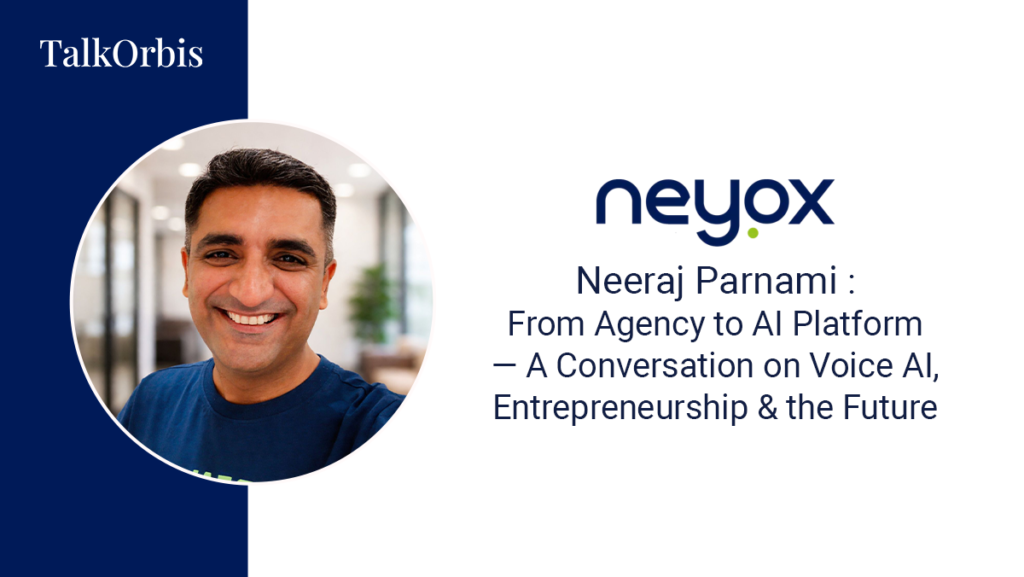
Founder - Neyox.ai, Jaipur
His journey from running a digital agency to building Neyox.ai, a scalable Voice AI platform solving real business challenges. It explores how Voice AI is transforming customer communication through automation, speed, and intelligent interactions.
SUMMARY
- Voice AI platform
- AI-driven business growth
- Entrepreneurship & Automation
What core problems does Neyox.ai aim to solve for businesses today?
At the heart of it, Neyox.ai solves three interconnected problems. First, speed-to-lead — the window between a prospect showing interest and a business responding is often the difference between winning and losing a customer. Second, operational overload — most businesses simply cannot afford to staff around the clock for inbound queries, follow-ups, and appointment management. Third, inconsistency — human-led processes vary in quality depending on who’s on shift, their mood, their training. Neyox.ai eliminates all three by deploying intelligent Voice AI agents that respond instantly, operate 24/7, and maintain a consistent, professional experience every single call.
How does Voice AI change the way companies handle lead qualification, appointments, and customer support?
Fundamentally. Before Voice AI, lead qualification meant a human had to make time, dial a number, ask scripted questions, update a CRM, and hope the lead was still warm. That chain has multiple failure points. With Neyox.ai, the moment a lead comes in, a Voice AI agent initiates a natural conversation, qualifies based on pre-defined criteria, gathers relevant details, and either books an appointment or routes the lead appropriately — all in real time. For appointments, the AI integrates directly with calendars, handles rescheduling, sends reminders, and reduces no-shows dramatically. In customer support, it manages FAQs, order updates, escalation logic, and satisfaction checks — all without a human in the loop unless truly necessary. The shift is from reactive to proactive, and from linear to parallel — one AI can handle hundreds of conversations simultaneously.
As a founder, I always believed we were building more than an agency — we were laying the foundation for a scalable AI platform that could create long-term value.
Why was a no-code, scalable approach important while designing Neyox.ai?
Because the businesses that need this the most are not the ones with large IT teams and engineering resources. They’re the ambitious SMBs, the growing real estate agencies, the healthcare clinics, the e-commerce brands — businesses that have genuine operational problems but don’t have months to implement a custom tech solution. A no-code approach meant we could democratize access to enterprise-grade Voice AI. It also meant faster deployment, easier customization, and lower barriers to adoption. Scalability was equally critical — a business that starts with one AI agent today might need fifty next year. The architecture of Neyox.ai was built to grow with our clients, not create a ceiling above them.
Building a product is very different from running a service agency. What has been the biggest mindset shift for you?
In an agency, you are rewarded for solving immediate, custom problems. Every client is unique, and your value is in your ability to adapt and deliver. But in product thinking, you have to resist that instinct constantly. You have to ask — is this a feature for one client, or a feature for thousands? The biggest mindset shift has been moving from customization to standardization — learning to say no to specific requests in the short term in service of building something universally powerful. Another major shift has been around patience. Agency work is transactional — effort in, result out, invoice sent. Product building is compounding — months of effort sometimes yield no visible output before suddenly everything clicks. Learning to trust the process, and stay committed to the long arc, has been the most important internal evolution I’ve undergone.
What were the early challenges while building Neyox.ai — technology, adoption, or trust?
Honestly, all three — but in different phases. The first challenge was technology. Getting Voice AI to sound natural, handle interruptions, manage ambiguous conversations, and integrate with diverse CRM and calendar systems was genuinely hard. The second challenge was trust. Businesses are skeptical of automating customer-facing touchpoints — and rightly so. A bad AI interaction can damage a brand. We had to obsess over quality, over the voice and tone, over failure handling. The third and perhaps most enduring challenge is adoption. Even when businesses see the ROI clearly, change management within organizations is slow. People are comfortable with what they know. Our job wasn’t just to build great technology — it was to educate, demonstrate, and hold clients’ hands through the transition.
The real shift we are driving at Neyox.ai is from manual execution to intelligent decision-making. As a CEO, my vision is to build a system where businesses don’t just automate conversations, but actually learn from them and continuously improve how they grow.
How did your experience in digital marketing influence the way you built this product?
Deeply. Digital marketing is fundamentally about understanding human behavior, messaging, and conversion funnels. That perspective shaped everything about how we designed Neyox.ai — especially the conversational flows. Our AI agents don’t just ask questions mechanically; they’re designed like great marketers — empathetic, persuasive, and goal-oriented. My background also gave us an edge in go-to-market. I understood distribution, positioning, and how to build credibility in a crowded market. And perhaps most importantly, working with hundreds of businesses across industries taught me what their real pain points were — which meant we were building solutions for validated problems, not theoretical ones.
Voice AI is evolving rapidly. Where do you see this technology heading in the next 3–5 years?
We are moving from Voice AI that executes tasks to Voice AI that understands context, builds relationships, and drives decisions. In the next 3–5 years, I expect Voice AI to become indistinguishable from human conversation in most business contexts. We will see AI agents that remember customer history across interactions, adapt their communication style to individual personalities, and proactively reach out based on behavioral triggers. Multi-language fluency at a near-native level will break down global barriers for businesses of all sizes. On the infrastructure side, Voice AI will be deeply embedded into business operating systems — not a feature you switch on, but the connective tissue of how companies communicate. The businesses that start building with Voice AI today are not just saving costs — they are building a strategic moat that will be very difficult to replicate later.
How do you balance innovation with responsible AI usage, especially in customer-facing automation?
This is a question I take very personally. At Neyox.ai, we have a set of non-negotiables. Every AI interaction must be transparent — customers always have the option to know they are speaking with an AI and to be transferred to a human. We do not deploy AI in contexts where it could mislead or exploit vulnerable individuals. Our conversational flows are designed with empathy, not manipulation. Beyond that, we build in human escalation protocols so that any interaction showing signs of distress, complexity, or sensitivity is immediately handed off. Responsible AI is not a constraint on innovation — it is the foundation that makes innovation sustainable. Businesses that cut corners on ethics in AI will eventually face a reckoning with their customers and regulators. We want to be on the right side of that.
What makes Voice AI a stronger engagement tool compared to chat or text-based AI?
Voice is the most natural form of human communication. It carries urgency and nuance that text often cannot replicate. When a Voice AI agent calls a lead within seconds of their inquiry, the experience is immediate and personal — it doesn’t feel like automation; it feels like responsiveness. Engagement rates on voice interactions are significantly higher than text. People complete voice conversations at a far greater rate than they respond to chatbot sequences. For high-stakes interactions — healthcare appointments, financial consultations, real estate inquiries — voice creates a level of trust and clarity that text often cannot. There is also a practical dimension: not everyone types well or comfortably, but nearly everyone speaks. Voice AI is one of the most universally accessible forms of intelligent automation available.
Who is Neyox.ai built for, and which industries are showing the strongest adoption?
Neyox.ai is built for any business where speed-to-lead, appointment management, and customer communication are critical to revenue. In practice, the strongest early adoption has come from real estate — where agents deal with high inquiry volumes and time-sensitive leads. Healthcare clinics are another strong vertical — managing patient appointment bookings, reminders, and follow-ups with zero administrative overhead. Financial services companies use us for initial client qualification and consultation scheduling. E-commerce brands leverage Neyox.ai for post-purchase support and retention outreach. Education and coaching businesses are also showing strong traction, particularly for enrollment follow-ups. The common thread is not the industry — it’s the need to communicate at scale without compromising quality.
How do businesses measure ROI when adopting Voice AI solutions?
ROI with Neyox.ai manifests across multiple dimensions. The most immediate is cost reduction — replacing manual calling and follow-up teams with AI delivers 60–80% savings in operational costs in most cases. The second is revenue impact — measurable through improvements in lead conversion rates and appointment show rates. Clients consistently report 30–50% higher lead conversion when AI handles first-touch qualification versus delayed human follow-up. The third dimension is time — how much faster are leads being contacted, qualified, and moved through the funnel? We help businesses track average response time as a core KPI. Beyond the numbers, there is also a qualitative dimension — the mental bandwidth freed up for sales teams to focus on high-value conversations, and the confidence that no lead is being neglected.
What has been the most surprising use case of Neyox.ai so far?
One that genuinely surprised me was in the wellness industry. A yoga and wellness studio was struggling with what they called the drop-off problem — people who would express interest, sometimes even make a booking, and then go silent. They used Neyox.ai to run gentle, conversational re-engagement calls. The AI would check in with warmth, ask about their goals, and make them feel seen and supported. The re-engagement rate was extraordinary — far beyond what email campaigns had ever delivered. What struck me was that the customers reported feeling cared for by those calls. They didn’t know it was AI. They just felt like the studio was paying attention. That told me something profound: Voice AI is not just an efficiency tool — in the right application, it is a relationship-building tool.
As CEO, one of the biggest realizations for me was that growth cannot depend on linear effort. Agencies grow by adding people, but platforms grow by building systems. That shift in thinking is what led us to create Neyox.ai — a solution designed to scale outcomes, not just operations.
You are known as a futurist thinker — how do you personally stay ahead of technology trends?
Curiosity is a discipline for me. I dedicate time every single day to reading — not just tech news, but first principles research, academic papers, and the thinking of people who are building the next decade’s infrastructure. I follow the convergence points — where AI, voice technology, behavioral science, and business operations intersect is where the most interesting things happen. I also stay close to our customers. Their frustrations today are almost always a signal of where technology needs to go next. Beyond that, I believe in learning by doing. Theoretical understanding has limits; the real insights come from deploying, iterating, and watching how humans actually interact with AI in the wild. I’d rather be wrong fast and right eventually than cautious and irrelevant.
What long-term vision do you have for Neyox.ai — as a tool, a platform, or an ecosystem?
Today, Neyox.ai is a powerful tool for Voice AI deployment. In the near term, we are building toward a platform — where businesses can not only deploy AI agents but customize their intelligence, integrate with their entire business stack, and monitor performance through deep analytics. The long-term vision is an ecosystem where Neyox.ai becomes the operating layer for business communication intelligence — connecting sales, support, retention, and relationship management through a unified AI infrastructure. Think of it as the central nervous system of a business’s customer communication. Developers will build on top of it, partners will integrate their tools into it, and businesses of all sizes will run critical functions through it.
Do you see Neyox.ai evolving beyond automation into intelligence-driven decision-making?
Today, our AI agents automate execution: calling, qualifying, booking. Tomorrow, they will augment strategy: predicting which leads are most likely to convert, recommending the optimal time and tone for outreach, flagging at-risk customer relationships before they churn. The layer beyond automation is insight — and beyond insight is foresight. We want Neyox.ai to be the system that not only executes business communication but advises on it. A business owner should be able to ask Neyox.ai: why are our show rates dropping? What message is resonating most with our highest-value leads? The future of Neyox.ai is not just doing more — it’s knowing more and helping businesses lead smarter.
What advice would you give to agency owners thinking about building their own SaaS or AI product?
The most dangerous thing an agency owner can do is build a product because AI is hot, not because they understand a specific, painful, recurring problem deeply. Your agency experience is your unfair advantage — use it. You have client relationships, domain expertise, and real-world feedback loops that most product founders would kill for. But you must be prepared for the identity shift. An agency is a services business — it rewards responsiveness and customization. A product business rewards patience, standardization, and long-term thinking. Build your first version with your most trusted clients. Iterate in the field. And most importantly — separate your product revenue from your agency revenue early, or the agency will always consume the urgency and resources that the product needs.
What skills should young entrepreneurs develop to build future-ready businesses?
First, systems thinking — the ability to see how different parts of a business, technology, or market interact and reinforce or undermine each other. Second, communication — not just the ability to speak or write well, but the ability to translate complex ideas into simple, compelling narratives for different audiences. In the AI era, the people who can explain and sell ideas will have enormous leverage. Third, learning agility — the willingness to unlearn and relearn rapidly. The technical landscape changes every six months. The entrepreneurs who thrive will be the ones who can absorb new paradigms quickly and apply them before their competitors realize the shift has happened. Beyond skills — develop resilience. Entrepreneurship is a long game played in short, often brutal sprints.
What mistakes should first-time product founders avoid?
The most costly mistake is building in isolation. Too many first-time founders spend months perfecting a product before showing it to a single real customer. By the time they launch, the market has moved, or worse — the problem they thought they were solving wasn’t actually the problem. Talk to customers obsessively before you write a line of code. The second mistake is confusing activity with progress. Building features, attending events, posting content — these feel productive but can be avoidance behavior. Real progress is measurable: users acquired, conversations held, revenue generated, problems solved. Third — underestimating distribution. The best product with no distribution strategy will lose to a mediocre product with great distribution every time.
For marketers, the biggest shift today is moving from attention to intent. It’s no longer about reaching more people — it’s about reaching the right people at the right time with the right message, and technology like AI is making that precision possible.
Trending Interviews


Trending Interviews
Related Popular Interviews
-
 By Prerna Saini | March 11, 2026
Divyansh Gupta: The Mind Behind Vipnik Studio’s 3D Animation
Read More